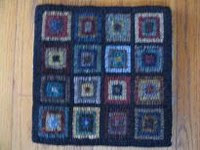
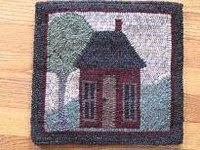
Rugs have been made in the Maritimes since Europeans first settled here. There is evidence to suggest that rugs were made in Great Britain during the eighteenth century and it is known that rugs were made in Nova Scotia in the nineteenth century.
Rug hooking came from thrumming, which is a process in which yarn (thrum) is inserted into canvas. At the beginning of the nineteenth century, the craft was already well developed, but by the end of the century the art of homemade rugs was in decline because of the availability of commercially made rugs.
There are two tools needed for rug hooking: a frame and a hook. The hook, which is used for pulling the nap (surface cloth) up through the backing, is similar to a heavy crochet hook. Hooks of the nineteenth century were made from a thin nail inserted into a wooden handle. The point of the nail was rounded and then barbed.
The frame consisted of four wooden slats. Canvas was tacked to the two longest slats and the backing for the rug was sewn to it. Some rug hookers also attached the rug to the smaller sides of the frame with yarn. Iron clamps were used to hold the frame together in a rectangle shape and it was set on wooden legs so that the rug hooker could sit down to work.
The backing that was used for rugs was almost exclusively made of burlap from old feed bags. These were easy to get and the burlap was strong. Weak burlap could seriously shorten the life of a rug.
Designs were draw on the burlap with “firecoal” - a piece of charcoal from the wood stove. To hook a rug, a strip of material is held under the burlap and then hooked up through with the hook. Four to ten loops per inch are common, with six or seven being the best for floor rugs. Our craftspeople make rugs in this traditional fashion at the Temperance Hall. The rugs are used in many of the buildings on site and may also be purchased by visitors to the Village.